Industry-Oriented Curriculum
Designed in consultation with healthcare experts to meet current hospital and patient care requirements.
Build a Rewarding Healthcare Career with Multiple Exit Options & Global Opportunities
Looking for a healthcare course after 12th PCB that is not MBBS or B.Sc Nursing? This is a 3-year, industry-oriented undergraduate degree that combines strong academic foundations with practical clinical training, hospital exposure, professional skill development and an optional Indo-German healthcare career pathway. It is awarded by Medhavi Skill University and delivered with MeduClinic and partner hospitals.
Considering B.Sc Nursing, BMLT, BPT, Radiology, OT Technology, Dialysis, Optometry, Cardiac Care, Emergency Medical Technology or Hospital Administration? B.Voc in Healthcare is another recognised route into the same hospital careers, with a degree, hands-on training from Year 1 and placement support.
B.Voc (Bachelor of Vocation) in Healthcare Assistance & Integrated Patient Care is a 3-year undergraduate degree for students who have completed 12th with Physics, Chemistry and Biology. It combines classroom learning with hands-on hospital training from the first semester, and prepares you for patient care, clinical coordination and healthcare supervision roles in India and, optionally, in Germany.
The Bachelor of Vocation (B.Voc.) in Healthcare Assistance & Integrated Patient Care is a 3-year, industry-oriented undergraduate degree designed to prepare students for the rapidly growing healthcare sector in India and abroad. The Program combines strong academic foundations with practical clinical training, hospital exposure, professional skill development and an optional Indo-German healthcare career pathway.
Developed in alignment with the National Education Policy (NEP) 2020, the National Credit Framework (NCrF) and the Academic Bank of Credits (ABC), the Program provides multiple exit options, credit mobility and flexible career progression. Students can complete the full degree or exit after Year 1 or Year 2 with nationally recognised qualifications while retaining their earned academic credits.
Why Choose
Designed in consultation with healthcare experts to meet current hospital and patient care requirements.
Earn a recognized qualification after every academic year.
Credits are stored in the Academic Bank of Credits (ABC), allowing students to continue their education anytime without losing academic progress.
Hands-on training in hospitals, rehabilitation centres, long-term care facilities, community healthcare settings and home healthcare.
Optional Indo-German Healthcare Pathway with integrated German language training (A1-B2) during Year 1, subject to language proficiency, employer selection, visa approval and applicable regulations.
Focus on clinical competence, communication skills, professionalism, patient safety and healthcare management.
Career Growth Opportunities
India's hospitals, home-care providers and elder-care services need trained people who can assist doctors and nurses, support patients through recovery and keep care running safely. Ageing populations, more chronic illness and the growth of private hospitals and medical tourism have increased demand for skilled patient care staff, and the same pattern is visible in Germany. This degree is built to place you in that gap with a recognised qualification, not just a short certificate.
Germany requires approximately 500,000 additional nurses and hundreds of thousands of general healthcare workers by 2030
Your goal is to become a doctor (MBBS) or a registered nurse (B.Sc Nursing or GNM). This degree leads to assistance, coordination and supervisory roles, not a medical or nursing registration.
If you are unsure, talk to a counsellor. It takes 10 minutes and there is no commitment.
Who Can Apply?
Students fulfilling the following criteria are eligible:
10+2 (Higher Secondary)
Science stream preferred (Physics, Chemistry & Biology)
Students awaiting results may apply (subject to eligibility)
Good communication skills and willingness to work in healthcare
B.Voc vs MBBS vs Nursing
If you've finished 12th PCB, you're probably choosing between MBBS, B.Sc Nursing, a general B.Sc, a paramedical or allied health course, or a vocational degree like B.Voc. It's a confusing decision. Here's how B.Voc in Healthcare Assistance & Integrated Patient Care compares.
| Factor | B.Voc Healthcare Assistance | MBBS | B.Sc Nursing | Paramedical / Generic Diploma |
|---|---|---|---|---|
| Duration | 3 years (multiple exit points) | About 5.5 years including internship | 4 years | 1-2 years |
| Recognised degree | Yes (UGC, NEP 2020) | Yes | Yes | No (diploma only) |
| Entry route | 12th PCB | 12th PCB + NEET-UG | 12th PCB (as per state / INC norms) | 12th, varies |
| Clinical training | From Year 1 | Clinical exposure mainly in later years | Mostly from Year 2-3 | Limited |
| Exit options | Certificate / Diploma / Degree | None before full completion | None before full completion | N/A |
| Registration | No. Assistance, coordination and supervisory roles | Yes (doctor) | Yes (nurse) | No |
| International pathway | Optional Indo-German (Germany) | Self-arranged, complex | Rare, self-arranged | Rare |
| Best for | Early hospital exposure + flexible career path | Becoming a doctor | A dedicated nursing career | Fastest entry, limited scope |
This comparison is for general guidance. Speak to our counsellor to see which path fits your goals best.
if you want to become a practising doctor and are ready for a long, entrance-exam-driven route.
if you want to be a registered nurse.
if you need the fastest possible entry and are comfortable with limited career growth.
if you want a recognised degree, early hospital experience, flexibility to exit and re-enter, and an optional route to Germany.
Not sure whether this is the right path for you? Talk to one of our counsellors. No commitment, just clarity.
B.Voc as a Career Option
Most students have heard of B.Sc Nursing, BMLT or BPT but not of B.Voc. If you are looking at any course below, B.Voc in Healthcare Assistance & Integrated Patient Care is another way into the same hospital world: a 3-year recognised degree, hands-on training from Semester 1, a qualification at the end of every year and placement support. The right choice depends on the role you want, so each description says where B.Voc fits and when the other course is the better pick.
B.Sc Nursing is a clearly defined clinical career with strong student interest. B.Voc shares the hands-on side: basic nursing care, vital signs, patient safety, geriatric and home healthcare, with ward exposure from Year 1. B.Voc leads to patient care assistance, coordination and supervisory roles and is not a nursing registration route. Choose B.Sc Nursing if you want to practise as a registered nurse. Choose B.Voc if you want a patient-care career with a faster start and exit options.
B.Sc Medical Laboratory Technology is a popular allied-health course focused on diagnostic laboratory work. B.Voc is patient-facing rather than lab-based: you learn clinical observation, documentation, infection control and ward workflows. Choose BMLT if you want to work in a pathology or diagnostic lab. Choose B.Voc if you prefer working directly with patients and hospital teams.
B.Sc Radiology & Imaging Technology suits students drawn to technical hospital careers around imaging equipment. B.Voc builds patient handling, patient positioning, safety and hospital operations skills, but does not train you to operate imaging machines. Choose Radiology & Imaging if you want to work with X-ray, CT or MRI. Choose B.Voc if you want broader patient care and hospital coordination roles.
The Bachelor of Physiotherapy is a recognised route for students interested in patient rehabilitation. B.Voc includes rehabilitation care, elder care and rehabilitation support from Year 2, and leads to roles such as Rehabilitation Assistant and Rehabilitation Coordinator. It does not qualify you to practise as a physiotherapist. Choose BPT if you want to assess and treat patients as a physiotherapist. Choose B.Voc if you want to support rehabilitation within a wider care team.
B.Sc Operation Theatre Technology is closely tied to hospital work and clinical support. B.Voc covers infection prevention, PPE use, patient safety, clinical procedures and hospital workflow, which are the same foundations OT teams rely on. Choose OTT if you want to work inside the operation theatre. Choose B.Voc if you want broader ward, patient care and coordination options.
B.Sc Dialysis Technology is a specialised, patient-facing role in kidney care. B.Voc gives you general patient care, chronic disease management and clinical documentation skills, but not dialysis machine training. Choose Dialysis Technology if kidney care is your goal. Choose B.Voc if you want to keep your options open across departments.
The Bachelor of Optometry is an alternative clinical career focused on eye care. B.Voc is a general healthcare degree and does not train you in eye examination or vision correction. Choose Optometry if eye care is what you want to do. Choose B.Voc if you want a wider hospital career.
B.Sc Cardiac Care Technology offers specialised allied-health training in cardiac care. B.Voc teaches vital-sign monitoring, clinical observation, first aid and emergency care that support cardiac patients, without the equipment-level specialisation. Choose Cardiac Care Technology if you want to work in cardiology units or cath labs. Choose B.Voc if you want general patient care first and the option to specialise later.
B.Sc Emergency Medical Technology is relevant to students interested in emergency and trauma care. B.Voc includes first aid, emergency response and patient safety training, but is not an ambulance or trauma-technician qualification. Choose EMT if you want to work on ambulances or in trauma teams. Choose B.Voc if you want emergency awareness within a broader patient-care career.
BBA and B.Sc Hospital Administration suit students who prefer hospital operations to direct clinical care. B.Voc is the strongest overlap here: Year 3 covers hospital operations, healthcare quality, leadership, supervision and healthcare management, and graduates can move into roles such as Hospital Coordinator or entry-level Healthcare Manager, then to MBA Hospital Administration or MSc Healthcare Management. The difference is that you also learn real patient care first, which many hospital managers lack.
Not sure which one fits you? Talk to a counsellor. We will tell you honestly if another course suits you better.
About Medhavi Skill University
Your degree matters as much as your training, so here is exactly who awards it.
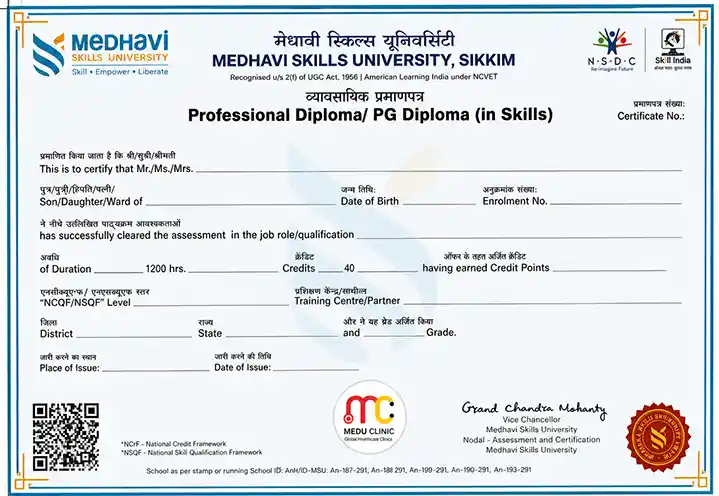
Medhavi Skill University is a private university, focused on skill-based higher education aligned with NEP 2020 and the National Credit Framework. The B.Voc in Healthcare Assistance & Integrated Patient Care is offered under its name.
| Recognition | Detail |
|---|---|
| Recognition | UGC-recognised university |
| Established | 2021 |
| Location | Ratamatey Thangsing, Barnyak, Barthang, Hee Burmiok, Sikkim 737111 |
| Degree awarded | Bachelor of Vocation (B.Voc.) in Healthcare Assistance & Integrated Patient Care |
| Credit system | NCrF and Academic Bank of Credits (ABC) aligned |
Awards the Certificate, Diploma and Degree; approves the curriculum; conducts assessments
Admissions and counselling, German language training, placement support, Germany pathway guidance
Clinical training, rotations and internships
Curriculum Overview
Every year ends with a nationally recognised qualification, so you always leave with something that counts.
Qualification Awarded
UG Certificate in Healthcare Assistance
Credits Earned
40 CreditsStudents develop a strong understanding of human anatomy, physiology, medical terminology, infection control, communication skills and professional behaviour while learning basic patient care techniques.
Students become competent in assisting patients with daily activities, monitoring vital signs, documentation, first aid and maintaining safe healthcare environments.
Students gain intermediate clinical skills in geriatric care, rehabilitation, nutrition, home healthcare and chronic disease management.
Students develop confidence in clinical decision support, patient documentation, multidisciplinary teamwork and healthcare service delivery.
Students learn healthcare leadership, hospital operations, healthcare quality, patient safety and supervisory responsibilities.
Students complete an advanced clinical internship, demonstrate professional competency, manage patient care workflows and prepare for employment or higher education.
Practical Hospital Training
This is not a classroom-only degree. From Semester 1, you practise real care skills under supervision, and your exposure grows every year.
Ward exposure and skills practice: vital signs, patient positioning, wheelchair transfers, hand hygiene, bed making, PPE use and documentation.
Clinical care across settings: geriatric care, rehabilitation support, home healthcare and palliative care.
Hospital internship, clinical rotations and a capstone project, with team-leadership and quality-improvement work.
Where you will train: hospitals, rehabilitation centres, long-term care facilities, community healthcare settings and home healthcare.
After Year 1
40 credits
After Year 2
80 credits
After Year 3
120 credits
Students may pause their education after Year 1 or Year 2 and resume later through the Academic Bank of Credits without losing earned credits, subject to institutional and regulatory guidelines.
Future Career Paths
Career progression
| Stage | India Track | Global Track |
|---|---|---|
| After 1st Year | Rs. 2 Lacs / Year | Rs. 30 Lacs / Year |
| After 2nd Year | Rs. 3 Lacs / Year | Rs. 35 Lacs / Year |
| After 3rd Year | Rs. 4 Lacs / Year | Rs. 40 Lacs / Year |
*Terms and conditions apply. Germany pathway outcomes depend on language level, employer selection and visa approval and are not part of this guarantee.
Where you can work
Graduates may pursue:
Job Placement Support
Our placement promise
Placement support: “Every student who completes the Program and meets the attendance and assessment criteria is completely supported for a job offer/placement.”
*Terms and conditions apply. Germany pathway outcomes depend on language level, employer selection and visa approval and are not part of this guarantee.
Work in Germany
Students can opt for the Indo-German Healthcare Pathway, where German language training is integrated alongside Year 1 academics. After successful completion of academic requirements and achieving the required German language proficiency, eligible students may pursue vocational training (Ausbildung) or employment opportunities within Germany's healthcare sector, subject to employer selection, regulatory requirements and visa approval.
German language classes (A1 onwards) run alongside your academic year.
Continue towards B1 and B2 while building clinical skills.
Healthcare terminology in German, interview practice and cultural orientation.
We connect eligible students with German employers and training providers.
Documentation, visa guidance and pre-departure orientation.
Post-arrival integration support.
The Germany pathway is optional. You can complete the degree and work in India without it. Outcomes depend on language proficiency, employer selection, visa approval and applicable regulations.
Program highlights
The B.Voc course is a UGC-recognised degree aligned with NEP 2020. It provides a mix of classroom learning and hands-on work-related experience. Unlike traditional degrees, it provides recognised qualifications at each stage (after Year 1, after Year 2 and after Year 3), so you won't be without a credential.
Yes. In the National Credit Framework (NCrF) and in the new Education Policy NEP 2020, a finished B.Voc degree is regarded as equivalent to a Bachelor's and credits gained count towards the Academic Bank of Credits (ABC) for transfer or further study.
Yes. Under the National Credit Framework (NCrF) and NEP 2020, a finished B.Voc degree is regarded as equivalent to a Bachelor's degree, and credits gained count towards the Academic Bank of Credits (ABC) for transfer or further study.
The candidate should be 12th pass (10+2) Science stream, preferably with Physics, Chemistry and Biology. Students awaiting board results may also apply (if applicable).
Indo-German Healthcare Pathway students get integrated German language learning (A1-B2) in Year 1. Once students have met the academic and language requirements, they may apply for vocational training (Ausbildung) or job offers in the German healthcare industry, subject to employer choice, visa and regulatory approvals.
Eligible graduates can apply for roles in hospitals, clinics, rehabilitation centres, home healthcare services and diagnostic centres in India, and optionally in Germany, as Healthcare Assistant, Clinical Care Assistant, Patient Care Coordinator, Hospital Coordinator or Healthcare Supervisor.
The B.Voc in Healthcare Assistance & Integrated Patient Care is a 3-year, 6-semester programme.
It is another route into hospital careers, not a replacement for a licensed profession. B.Voc prepares you for patient care assistance, coordination and supervisory roles. If you want to practise as a registered nurse, physiotherapist, lab technologist, radiographer or optometrist, choose that specific course. If you want a broader patient-care career with early hospital exposure and exit options, B.Voc is built for that.
It depends on your goal. Choose B.Sc Nursing for a nursing career, a paramedical diploma for the fastest entry with limited scope, and B.Voc if you want a recognised degree with a qualification at every stage and an optional Germany pathway.
Yes. Year 3 covers hospital operations, healthcare quality and management, and graduates can pursue MBA Hospital Administration or MSc Healthcare Management, subject to the admitting institution's eligibility rules.
The degree is awarded by Medhavi Skill University. MeduClinic and partner hospitals deliver admissions, training and placement support.
It is a UGC-recognised Bachelor of Vocation degree under NEP 2020 and the National Credit Framework. For government jobs, check each recruiter's eligibility rules, as these vary by post.
No, NEET is not a needed.
You keep a recognised UG Certificate after Year 1 or UG Diploma after Year 2, and your credits are stored in the Academic Bank of Credits so you can return later, subject to institutional and regulatory guidelines.
No. The Germany pathway is optional. You can complete the degree and work in India without it.
Choose the campus closest to you, or speak to a counsellor about seat availability, hostel options and partner hospitals at each location.
Not sure whether this is the right path for you? Talk to one of our counsellors. No commitment, just clarity.

Get a conditional internship with a stipend upto ₹2,64,000*, depending on the internship location.
Secure a conditional offer letter at acceptance for jobs at 2000+ Lenskart stores nationwide.
The curriculum includes specialized training modules designed by Lenskart and regular visits to the stores.
Develop a strong foundation in the basics of optics, ocular anatomy, visual optics, pathology, binocular vision, among others.
Earn an exclusive Award of Completion from Lenskart.
B.Optom (SureStart with Lenskart)
3 or 4 years (including 18-24 months of integrated internship)
10+2 (any stream, pass) *
B.Optom (SureStart with Lenskart)
3 or 4 years (including 18-24 months of integrated internship)
10+2 (any stream, pass) *


